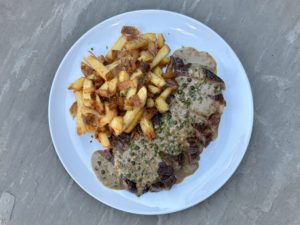
The most useful thing you can keep in your freezer
This is not a stock you make to use straight from the pot. It is a concentrate — a deeply coloured, gelatinous base designed to be reduced to a glace or demi-style sauce base and frozen in portions. No salt, ever. You salt at the sauce stage, after reduction, when you can judge the seasoning accurately. Salt before reduction and the finished sauce will be unworkable.
The method is restaurant standard. Roast the bones until deeply browned, caramelise the vegetables, reduce the wine until the acidity is gone, then simmer at the gentlest possible heat for as long as the bones will give. What comes out is dark, clean, and lightly gelatinous when cold.
Ingredients
| 5 kg beef bones | Mix of knuckle, marrow and joint bones. Knuckle and joint bones provide gelatin; marrow adds richness and colour. Ask your butcher to cut large bones into sections — more surface area means more extraction. |
| 1 kg onions | Roughly chopped, skin on. Skin adds colour to the finished stock. No need to peel. |
| 750 g carrots | Roughly chopped. Adds sweetness and body. Can be increased slightly without issue. |
| 500 g celery | Roughly chopped. Adds a clean, slightly bitter background note that balances the richness of the bones. |
| 2 tbsp tomato purée | Adds umami and depth of colour without adding tomato flavour. Do not substitute with passata or tinned tomatoes — the concentration is the point. |
| 250 ml dry red wine | Bordeaux-style, not fruity. Cabernet Sauvignon or Merlot based. Avoid jammy New World reds — they add sweetness rather than depth. Does not need to be expensive, but should be something you would drink. |
| 3 bay leaves | Added with the aromatics after skimming. Fresh or dried both work. |
| 1 small bunch thyme | Fresh. Added with the aromatics after skimming. |
| 12 black peppercorns | Whole. Added with the aromatics after skimming. Do not use ground pepper — it clouds the stock. |
| 6 litres cold water | Cold, not hot. Starting cold draws impurities from the bones slowly and makes skimming easier. |
Method
Spread the bones across one or two large roasting trays in a single layer. Roast at 220°C for 45–60 minutes, turning once, until deeply browned throughout — not golden, not pale brown. This is where the stock’s colour and depth comes from.
Add the onions, carrots and celery to the bone tray for the final 30 minutes of roasting. They should caramelise and colour at the edges — not burn.
Smear the tomato purée over the bones and vegetables for the final 10 minutes of roasting. It will darken and concentrate against the hot tray.
Remove the tray from the oven and pour in the wine while still hot. Scrape every bit of fond from the base — put the tray over a hob flame briefly if needed to loosen. Reduce until almost completely dry before transferring everything to the stockpot.
Transfer the bones, vegetables and deglazed juices to the stockpot. Cover with cold water by 3–4 cm. Bring very slowly to a bare simmer over medium-low heat — allow 30–40 minutes. Do not boil.
For the first 45 minutes after the stock reaches a simmer, skim continuously. A grey-brown foam will rise to the surface — remove all of it before adding the aromatics.
Once skimming is done, add the bay leaves, thyme and peppercorns. Maintain the gentlest possible simmer — the surface should barely move — for a minimum of 6 hours, ideally 8–10. Top up with water only if the bones become exposed.
Strain through a fine chinois or muslin cloth into a clean container. Discard the solids. Cool rapidly in a sink of iced water, then refrigerate overnight.
The next day, lift the solidified fat cap from the surface and discard. What remains should be dark, clean, and lightly gelatinous when cold — it should wobble slightly when the container is shaken.
Bring the degreased stock to a simmer in a wide, heavy pan. Reduce uncovered by 50–60%, skimming occasionally. Test by chilling a spoonful — it should set softly, not rubbery and not watery. Pour into ice cube trays, freeze solid, then transfer to labelled freezer bags.
Notes
No salt: Salt concentrates during reduction. A stock seasoned before reduction becomes unworkable by the time it reaches sauce consistency. Always salt at the sauce stage, after the stock has reduced to the level you need.
Scaling: This recipe scales proportionally — double the bones, double the water, double the aromatics. The simmer time stays the same regardless of batch size.
Bones: Ask your butcher to cut large bones into sections if they aren’t already — more surface area means more extraction. Marrow bones add richness; knuckle and joint bones add gelatin. A mix of all three gives the best result.
Wine: Use a Bordeaux-style dry red. Avoid fruity or jammy New World reds, which add sweetness rather than depth. It does not need to be expensive, but it should be something you would drink.
Yield: Approximately 4.5–5 litres before reduction. At 50% reduction, approximately 2–2.5 litres. Frozen in standard ice cube trays, expect 60–80 cubes.